
Why Learning Strategy on YouTube is Nearly Impossible (And What I Did About It)
A video crossed my feed this week that perfectly captured something I’ve been wrestling with for months.
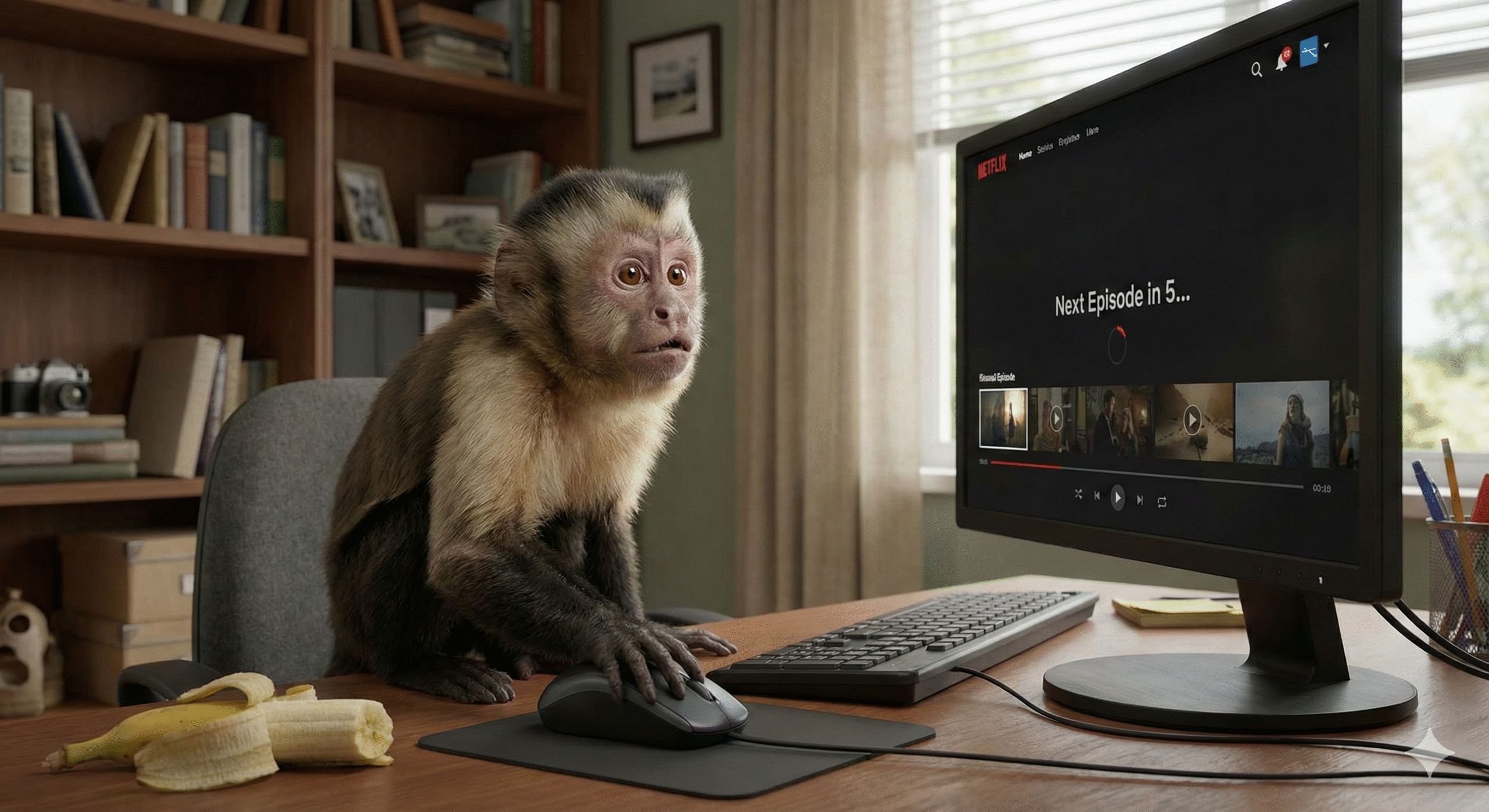
It’s called How the Algorithm Hijacked Monkey’s Brain | Strategy Cinema On-Demand and it’s a brilliant parody about how YouTube’s algorithm turns genuine learning into an endless dopamine loop.
“Monkey” (the protagonist) watches “How to Stay Focused,” then gets distracted by ice bath videos, then slides into “10 Signs You’re Secretly a Genius (Number 7 Will Blow Your Mind).”
Six hours later, Monkey has learned nothing.
The video is savage, funny, and uncomfortably accurate. But what hit me hardest wasn’t the parody itself—it was the explanation of why this happens.
Watch the full video here on StratCinema
My War with the Algorithm
Here’s what the Monkey video helped me understand about my own experience:
For the past few years, I’ve been cycling indoors 6 hours a week on Zwift. And instead of watching Netflix, I decided to watch business case studies. Kodak vs Fujifilm. Blockbuster’s collapse. Nokia’s missed smartphone revolution. Military strategy failures. I’ve watched 10+ corporate failure videos per week for months.
But YouTube fought me every step of the way.
The algorithm couldn’t understand what I was doing. It kept trying to “help” by showing me:
- Jamaican politics (because of my location)
- Donald Trump (because I have an opinion about his presidency and sometime the clickbait is alarming)
- Motivational content (because I watched one productivity video)
- Tech reviews (because I watched something about Nokia)
- Entertainment (because surely no one actually wants to learn this much and I watch the occasional music video)
To cope, I had to create a completely separate YouTube channel—following advice from Kallaway, an internet marketer who recommended keeping separate “trained channels” for different purposes. Then I spent weeks aggressively blocking every, single non-strategy recommendation that appeared. I had to train the algorithm like you’d train a puppy: “No. Not that. This. Only this.”
Now it works about 95% of the time.
But think about what that means: I had to fight YouTube just to get YouTube to show me what I actually wanted to learn.
The Algorithm’s True Purpose
The Monkey video explains why this is so hard. The algorithm isn’t designed for education. It’s designed for engagement—keeping your eyes on the screen by any means necessary.
As the video puts it:
- The algorithm gives you sugar, not vegetables
- It rewards entertainment, not education
- It sells motivation without movement
- It discovered the perfect drug: feeling like you’re learning without actually learning
Every thumbnail click gives you a dopamine hit. But real learning—the struggle, the frustration, the debugging—doesn’t trigger dopamine. So your brain learns to prefer clicking over doing.
The result? Monkey proudly says “I watched ten hours of coding tutorials this week”—but never opened the code editor once.
But Wait—Strategy is Different
Here’s where the Monkey video is absolutely right about the trap, but misses something crucial about strategy learning.
Strategy isn’t like coding. You can’t just “open the editor and start building.”
Strategy is what’s called an ill-structured domain—like medicine, military tactics, or relationships. The concepts exist, but the way they show up in real situations is endlessly varied and unique. You can’t learn this from frameworks alone.
Expert strategists don’t reason from abstract principles in the heat of the moment. Instead, they pull from a vast library of cases, fragments, stories, and patterns they’ve accumulated over time. Like Warren Buffett sending Katherine Graham of The Washington Post annual reports from companies as diverse as Coca-Cola and insurance firms—building her pattern recognition through exposure.
This is what researchers call tacit knowledge—the kind of expertise you can’t get from a textbook. It’s like balance on a bicycle: you can teach someone the physics, but they still need exposure and practice to develop the intuition.
For strategists, that means you need to see – perhaps – hundreds of varied cases before the frameworks even begin to make sense.
However, the Monkey video is also wrong.
Season 1: The Missing Foundation
Most people (and the Monkey video) conflate two completely different types of learning:
Season 1 Learning: Pattern recognition through curated exposure
- Curiosity-driven, entertaining, enjoyable
- Building mental libraries of cases and fragments
- Like walking through a museum having “Aha!” moments
- No pressure, no guilt, just discovery
Season 2 Learning: Deliberate, hard skill development
- Watching the same video 5 times
- Taking notes, buying books, hiring coaches
- Your limitations are right in front of you
- Intense, focused, sometimes frustrating
Monkey’s problem wasn’t watching videos. Monkey’s problem was watching random videos chosen by an algorithm optimized for clicks, not learning—and never transitioning from passive watching to active practice.
The Monkey video is right that you can’t stay in passive watching forever. But it’s wrong to dismiss Season 1 entirely. For ill-structured domains like strategy, Season 1 isn’t optional—it’s foundational.
(It’s no accident that the creator of the Monkey video used the example of a well-structured domain – programming/coding.)
Why I Built StratCinema
This is exactly why StratCinema exists.
It’s the “trained channel” I wish I’d had from day one—pre-curated, organized by strategic patterns, with no algorithm fighting your learning goals.
StratCinema solves three problems the Monkey video identifies:
- No algorithm manipulation → Cases are organized by pattern (disruption, long-termism, category design, etc.), not by what keeps you clicking
- Intentional Season 1 environment → Designed for guilt-free pattern recognition without the pressure of Season 2 intensity
- Clear transition signals → When you find yourself watching the same case 4-5 times because you’re genuinely curious about deeper questions, that’s your brain telling you it’s time for Season 2
StratCinema is designed to give you what YouTube can’t: a curated space for strategic pattern recognition without the algorithm’s interference.
The Path Forward
Browse the 100+ cases here on StratCinema. Don’t force it. Don’t feel guilty. Just notice which patterns make you curious:
- Companies destroyed by short-term thinking
- Disruption that seemed obvious in hindsight
- Strategic pivots that saved failing businesses
- Leadership decisions that changed entire industries
When you find yourself thinking “What was Kodak’s actual strategy?” or “How did Fujifilm see what Kodak missed?” or “What pattern connects these three failures?”—that’s your curiosity pointing you toward Season 2.
That’s when you watch a case 5 times. Buy Roger Martin’s books. Dig into the academic papers. Hire a coach. Join my newsletter on long-term strategy. Do the hard work.
But first, build the foundation. Season 1 matters.
The strategists who stay relevant aren’t the ones who memorize the most frameworks. They’re the ones who never stop exposing themselves to new cases, new patterns, new stories.
Start here: How the Algorithm Hijacked Monkey’s Brain | Strategy Cinema On-Demand, then explore cases that catch your attention.
Your curiosity will do the rest.
0 Comments