
![[Premium Clip] Workflow First Day One w Francis Wade](https://stratcinema.org/wp-content/uploads/sites/13/2026/09/fw-workflow-CLIP-first-day-one-live.png)
[Premium Clip] Workflow First Day One w Francis Wade
[Premium CLIP] Why does simply applying AI across your strategic planning process produce generic, unusable "trendslop"? In this session from the Long-Term Strategy Conference (LTSP26), Francis Wade breaks down why process management and workflow clarity must always precede AI adoption—not the other way around. While traditional process improvement works wonders on repeatable, physical manufacturing lines, strategy creation is an entirely different domain. It is low-frequency, idiosyncratic, and focused on creating "psychological objects"—shared alignment, executive consensus, and decisive strategic intent. Learn why mastering task automation differs from automating entire strategic roles, how to baseline non-physical workflows, and how to structure your strategic planning before bringing in AI tools. ---------------------------------------- This is a clip from the original 55 minute video only available to Premium Full Ticket holders.

Premium Clip - Breaking the Bank's Innovation Ceiling w Joe Pine
This is a clip from the full video available to Full Ticket Holders. Francis Wade and Joe Pine explore why many companies, especially banks, keep reaching for the same tired fixes even when innovation is clearly needed. The conversation centers on Pine’s progression of economic value and how it helps leaders see beyond products and services to experiences and transformations. Joe Pine brings decades of work on mass customization, the experience economy, and transformation, offering a lens that helps companies ask a better question: what business are we really in?
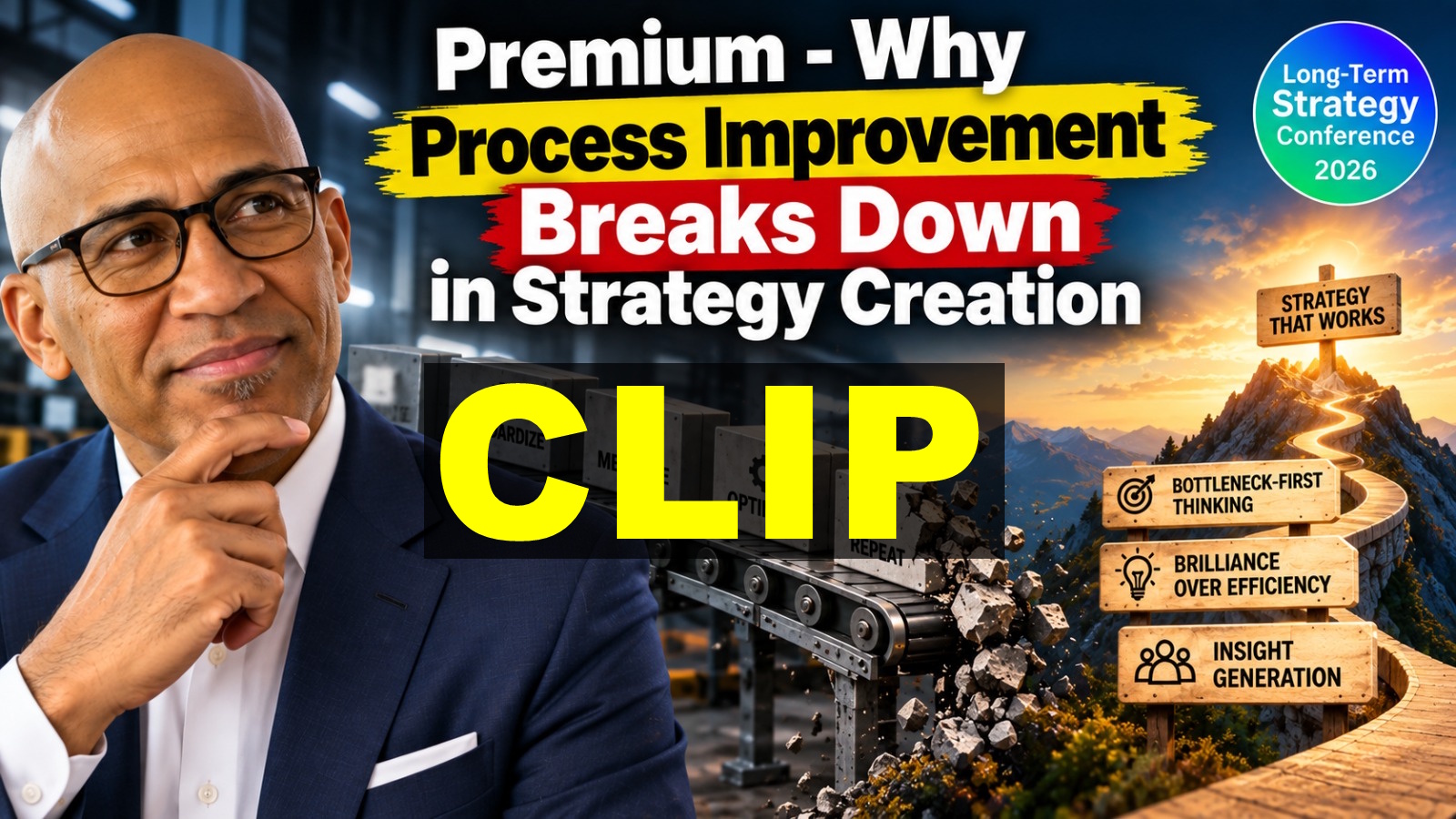
Why Strategy Needs Its Own Discipline: Bottlenecks, Brilliance, and Insights (Premium) CLIP
This session explores why strategy creation cannot be treated like factory-floor process improvement, especially as AI begins reshaping how organizations plan and decide. Francis Wade explains that strategy work is infrequent, ambiguous, and insight-driven, so teams need a different discipline from the one used for repetitive production systems. He introduces three lenses for the next 12 months: bottleneck-first thinking, decision-making optimized for brilliance rather than efficiency, and insight generation as the real engine of strategy.