

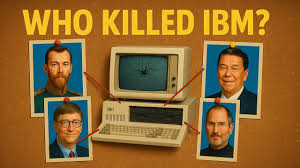
What REALLY Happened to IBM PCs? Shocking Truth Revealed!
The ultimate cause of market leader collapse is rarely external disruption—it’s internal strategic myopia, where a firm’s core structural advantages become its most dangerous liabilities. IBM’s late-century downfall exemplifies how bureaucratic ossification and architectural missteps can systematically dismantle a once-unassailable monopoly. The analysis reveals two critical strategic failures: *architectural openness* and *cultural disconnection from product-market evolution*. The 1981 IBM PC’s decision to use an open, non-proprietary architecture—incorporating Intel CPUs and Microsoft DOS—created an unpatentable standard, enabling Asian clones (e.g., Compaq) to capture 80% market share by 1990. Concurrently, a *cultural disconnection* manifested: senior leadership, including CEOs who didn’t use email, optimized for mainframe-era bureaucratic “fundamentals,” leading to product failures like the PC Junior—a machine that met 100% of internal requirements but 0% of consumer demand. For strategists, this is a masterclass in the perils of success. The forward-looking imperative is to audit *cultural proximity to the user* and *control over core architectural value*: when governance prioritizes internal process over external market reality, market leadership becomes terminal. --- **Timestamps** **00:07:21** Bureaucratic ossification: "Fundamentals" culture created 10 management layers—innovation required navigating a byzantine approval process divorced from market speed. **00:10:28** Architectural miscalculation: 1981 IBM PC used open, non-proprietary tech (Intel/MS-DOS), creating a replicable standard that ceded long-term platform control. **00:16:11** Cultural disconnection from users: PC Junior met 100% of internal slide-deck requirements but 0% of market demand—a product optimized for bureaucracy, not consumers. **00:21:59** Strategic rigidity in response: 1987 PS/2’s closed architecture failed—market had shifted to open standards, making proprietary lock-in a liability, not an asset. **00:25:14** Ecosystem defeat: OS/2 lost to Windows (10M vs. 2M copies by 1992) due to Microsoft’s superior developer network effects—IBM lost the platform war it initiated.








Not Rated Yet