

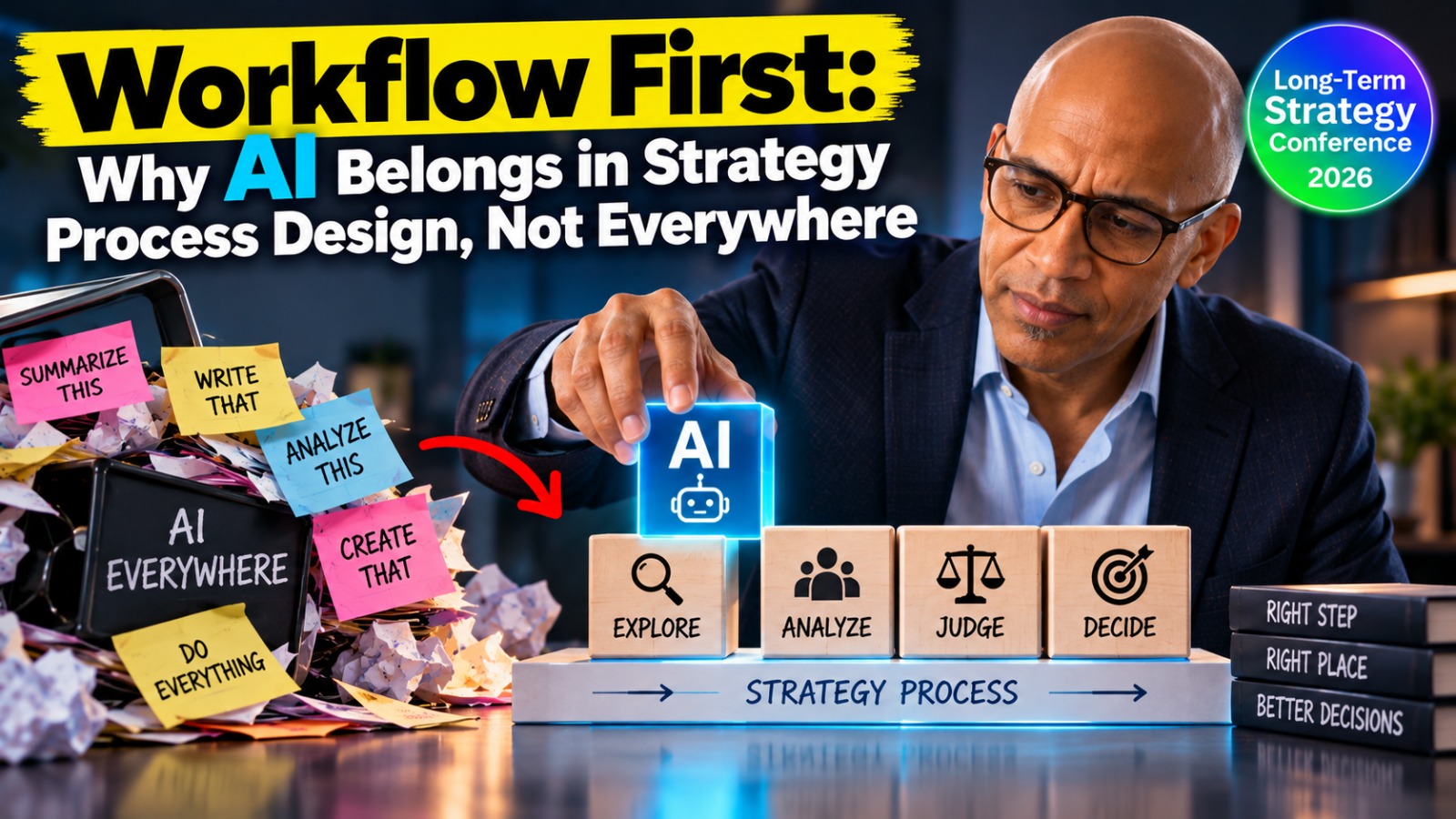
Workflow First: Why AI Belongs in Strategy Process Design, Not Everywhere Core #3
Most leaders get AI strategy wrong the same two ways: sprinkle it everywhere, or avoid it completely. Francis Wade argues the real fix isn't better prompting—it's understanding the workflow before AI ever enters the room. Strategy work is idiosyncratic and judgment-heavy, not repetitive like widget production, so it needs its own improvement logic borrowed loosely from theory of constraints: map where teams are diverging (generating options) versus converging (making defensible, ownership-bearing choices), then apply AI only to the diverging stages. Most organizations understand their strategy process only superficially—no documented steps, failure points, or measurements—which means AI often sounds most convincing exactly when a team is tired and least able to evaluate it, quietly producing polished answers nobody can defend later. The practical fix: simulate the process in smaller steps, adding AI selectively rather than issuing a blanket instruction to "use AI" across the whole workflow. Timestamps: 00:02:56 Strategy work has diverging stages, generating raw options, and converging stages, making defensible choices; AI belongs only in the diverging half 00:04:51 Theory of constraints suggests strategy needs bottleneck-first improvement logic, not the repetitive automation logic built for factory-style processes 00:09:27 Automation logic doesn't fit strategy creation because the work is infrequent and idiosyncratic, unlike a factory line producing identical widgets 00:14:25 Better prompting cannot fix a fundamentally flawed or undocumented strategy process, no matter how carefully the prompts are written 00:20:35 Simulate the workflow in smaller steps and apply AI selectively, instead of issuing a blanket instruction for teams to just use AI
- English (US)









Not Rated Yet