

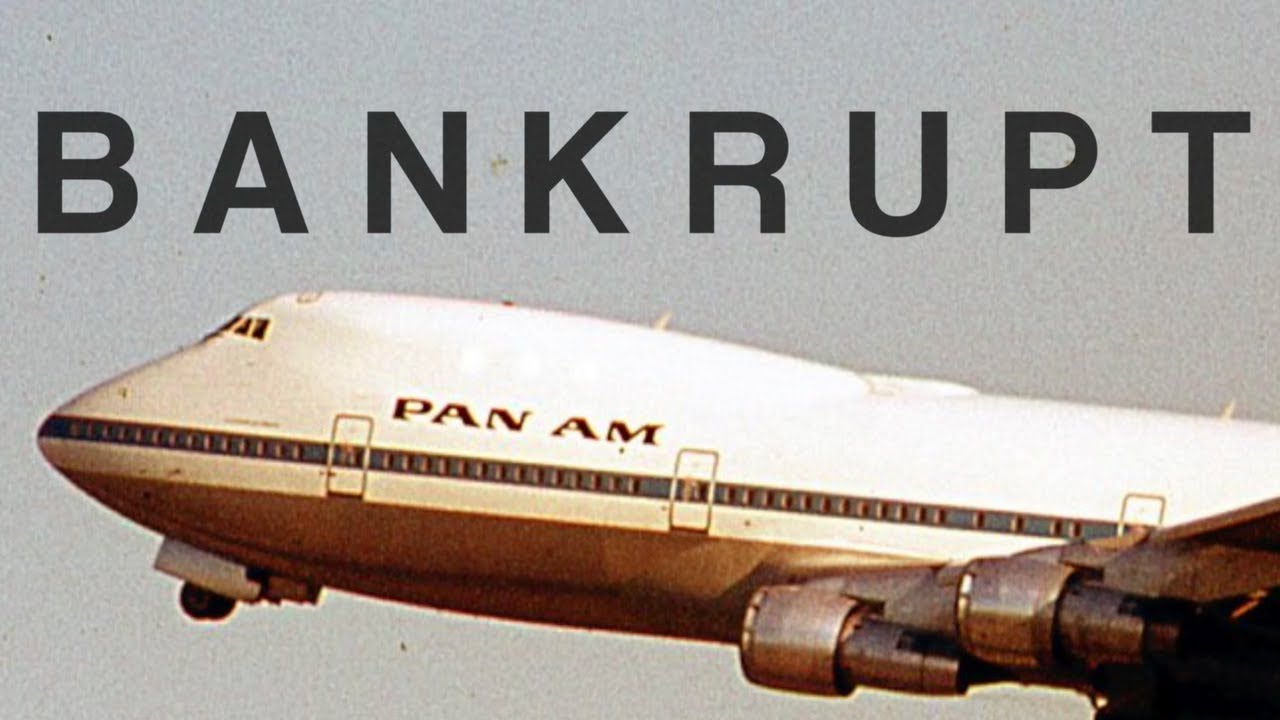
Bankrupt - Pan Am
Pan Am's collapse offers a counterintuitive lesson: pioneering an industry creates structural vulnerabilities invisible during prosperity. The world's first scheduled international airline, the launch customer for the Boeing 747, and the brand that defined global aviation went bankrupt not because it innovated too little—but because every strategic asset became a liability when conditions inverted. Three compounding mechanisms destroyed Pan Am. First, route concentration: lacking domestic feeder networks while competitors built balanced portfolios, Pan Am had no buffer when international demand softened. Second, fleet mismatch: 1973 oil shock quadrupled jet fuel costs precisely when Pan Am's four-engine 747s flew half-empty—operating losses hit $364M. Third, asset depletion as strategy: selling the Manhattan headquarters for $400M, Intercontinental Hotels, and the entire Pacific Division to United for $750M generated liquidity while eliminating future cash flows. Lockerbie added reputational collapse to financial distress. The implication: monoline dominance is fragility disguised as strength—diversification of routes, aircraft mix, and revenue streams matters most when survival is not yet in question. Timestamps: 00:01:18 First scheduled international flight (Key West to Havana, 1927) gave Pan Am unmatched route monopolies—and the absence of domestic networks competitors built. 00:06:39 1973 oil crisis quadrupled jet fuel costs while Pan Am's 747-heavy fleet flew half-empty—international-only exposure became structural vulnerability. 00:08:49 Pan Am sold Manhattan HQ for $400M, Intercontinental Hotels, then Pacific Division to United for $750M—liquidity from amputating future cash flows. 00:10:24 Lockerbie 1988: FAA charged 19 security failures, families sought $300M—reputational collapse compounded balance-sheet distress at exactly the wrong moment. 00:13:12 Gulf War 1990 collapsed transatlantic demand precisely when Pan Am had concentrated there—losing $3M daily, bankruptcy filing followed within months.
- English (US)
Recommended


The Trendslop Trap: Why AI Generates Mediocrity Instead of Strategy



The RUTHLESS 1980s Cassette Wars That FOOLED America (And Vanished)


Review
Add Review
You have to Sign In to share the review
Not Rated Yet