
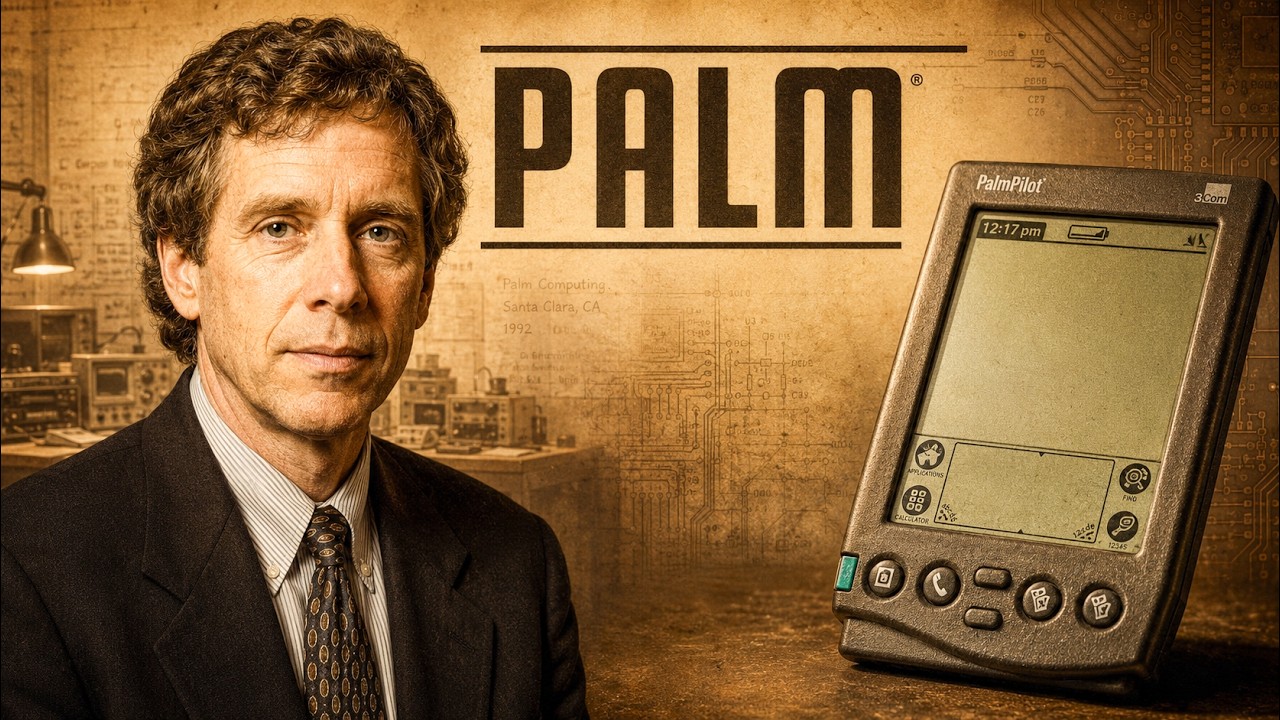
The Rise and Fall of Palm, the Santa Clara Startup That Built the First Smartphone and Lost to Apple
Jeff Hawkins tested the smartphone's core insight with a carved block of wood and a chopstick stylus, years before writing a line of production code. Palm's IPO would value it at $53 billion; its eventual sale, a decade later, fetched just $1.2 billion. Where Apple's Newton failed teaching computers to read handwriting, Palm's Graffiti taught users simplified strokes instead, and the Pilot 1000 sold a million units in 18 months on four functions only. Parent company 3Com refused to spin Palm off, prompting its own founders to leave and found rival Handspring, which built the Treo. Palm's CEO later dismissed Apple phone rumors outright: PC companies, he said, weren't going to just walk in and figure it out. Two months later, the iPhone shipped. The forward lesson: category-inventing advantage is perishable without structural independence to defend it. Palm's interface lives on in every smartphone gesture, under someone else's name. Timestamps: 00:00:34 Hawkins tested pocket-computer behavior with a carved wooden block and chopstick stylus before writing any production code 00:04:43 Graffiti inverted the Newton's failed approach: instead of teaching computers handwriting, it taught users simplified single-stroke input 00:08:13 Palm V's design-museum aesthetics and lithium-ion battery helped drive revenue up 400% to $563 million in four years 00:10:18 Palm's CEO publicly dismissed iPhone rumors as impossible for PC companies to solve, two months before the iPhone launched 00:11:56 Palm sold for $1.2 billion after a $53 billion IPO valuation — roughly one-fiftieth of its peak market value
- English (US)
Recommended

The Trendslop Trap: Why AI Generates Mediocrity Instead of Strategy
31 min English (US)
The RUTHLESS 1980s Cassette Wars That FOOLED America (And Vanished)
11 min English (US)


Review
Add Review
You have to Sign In to share the review
Not Rated Yet