

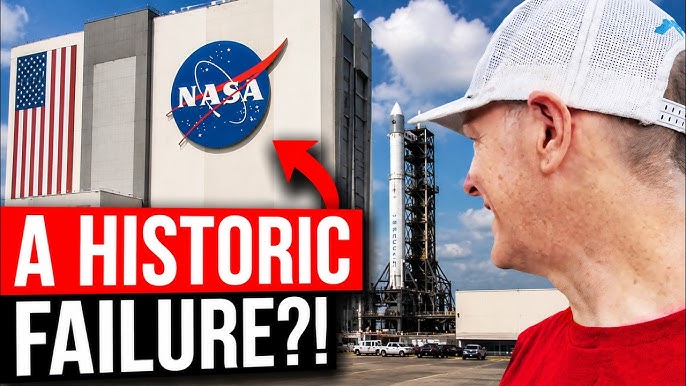
What Happened to NASA
NASA put men on the moon by 1969, then by 2011 paid Russia to fly its own astronauts to orbit. The failure wasn't underfunding — it was a mission accomplished with no second mission to replace it. Congress scattered NASA's facilities across key districts from the start, embedding political survival ahead of efficiency. Once Apollo succeeded, the organization defaulted to what economists call the institutional imperative: preserving itself rather than pursuing a new goal. Cost-plus contracts rewarded overspending. Shuttle-era compromises, including externally mounted boosters shaped by political rather than engineering logic, contributed to the Challenger disaster. NASA's own answer was fixed-price contracts for SpaceX, which built a reusable Falcon 9 for $390 million versus NASA's projected $1.5 billion. The forward-looking lesson: organizations without an external forcing function drift toward self-preservation. NASA's response — funding its own competitor — is the model worth studying now. Timestamps: 00:01:26 NASA was deliberately built as a civilian, not military, organization to channel Cold War fear into engineering ambition 00:06:01 Without Apollo's external threat, NASA defaulted to the institutional imperative: preserving the organization over any new ambitious mission 00:11:34 Challenger exploded because externally mounted boosters, positioned partly for political contract reasons, failed in cold weather engineers had flagged 00:20:45 Fixed-price contracts let SpaceX build a reusable Falcon 9 for $390 million versus NASA's own projected $1.5 billion 00:23:16 NASA's own new rocket, built partly from recycled shuttle parts for jobs, earned the nickname "Senate Launch System"
- English (US)
Recommended



The Trendslop Trap: Why AI Generates Mediocrity Instead of Strategy



The RUTHLESS 1980s Cassette Wars That FOOLED America (And Vanished)



Review
Add Review
You have to Sign In to share the review
Not Rated Yet