







loader image
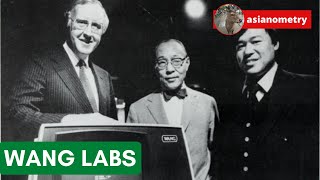
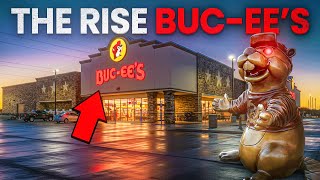
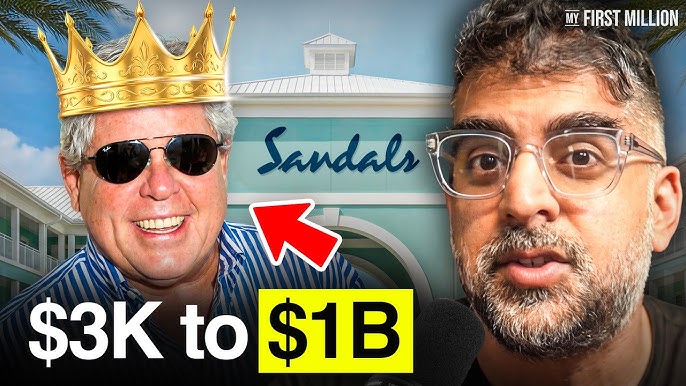
Butch Stewart: From Selling ACs to Becoming the Tourism King of Jamaica

Butch Stewart: From Selling ACs to Becoming the Tourism King of Jamaica

13 h
The most durable hospitality brands aren't built on location or luxury—they're built on positioning so precise it eliminates competition entirely. Butch Stewart's trajectory from $3,000 AC importer to Caribbean resort empire reveals a strategic logic most operators never locate. Against GE and Westinghouse, Stewart refused to compete on sales force scale. Instead: 8-hour installation guarantees and free repairs—asymmetric service commitments incumbents couldn't match without cannibalizing margins. That AC cash flow funded a 1981 distressed-asset acquisition of Bayrock in crime-ridden Montego Bay. His differentiating move wasn't renovation—it was radical segmentation. Couples-only positioning eliminated the family-romance conflict endemic to all-inclusive resorts and created a category. A 50% repeat rate, sustained for decades, validated the thesis. When the experience gap at Air Jamaica threatened brand coherence, Stewart vertically integrated—using the airline as a loss-leader billboard, subordinating economics to customer journey continuity. The lesson: category creation compounds. Stewart's real estate insight—the hardest property to build is in the consumer's mind—explains why Sandals became structurally unreplicable.
00:02:13 Stewart's AC breakthrough: instead of outselling GE, he asked what large competitors would never dare do—8-hour installation and free repairs. 00:04:21 All-inclusive pricing eliminated nickel-and-diming anxiety—the friction preventing aspirational travelers from committing to Caribbean luxury. 00:07:11 Couples-only positioning wasn't restriction—it resolved the fundamental conflict between romance guests and families, creating a category no competitor occupied. 00:10:05 Sandals sustained a 50% repeat rate for decades—the hospitality metric that reveals true quality better than any star rating. 00:12:42 Stewart bought Air Jamaica not as a business but as a vertically integrated brand touchpoint—the airline as a flying billboard, losing money to protect resort experience. (The remainder of the video is not relevant.)
Jamaica's Limestone Expansion

Jamaica's Limestone Expansion

31 h : 3 min
Jamaica's economic story is not written in tourist arrivals or remittance flows—it's carved from 50 billion tons of high-purity limestone. While the world catalogued this island as a beach destination, a geological endowment of exceptional calcium carbonate concentration was quietly becoming the foundation of a hemispheric industrial strategy. Lidford Mining's $2M WEN220 surface miner delivers 5x daily extraction versus traditional blast-and-drill, unlocking multi-grade streams: construction aggregate, pharmaceutical calcium carbonate, and food-grade supplements from one deposit. Revenue tripled to $10M in 2023. Kingston's post-Panamax crane investment converts Jamaica's Canal-adjacent position into logistics arbitrage—transshipment node for materials flowing toward Guyana's oil-funded construction surge. Jamaica's six-factor convergence—geology, geography, infrastructure, human capital, policy, market timing—creates a compounding advantage tourism economies cannot replicate. The pivot toward finished-goods manufacturing—paving stones, pharmaceutical tablets—signals deliberate value-chain ascent. With Guyana's construction boom accelerating and US Southeast demand growing, 2026 is the breakout year.
00:03:37 Jamaica's limestone advantage is purity, not volume: highest calcium carbonate concentrations on Earth translate directly into stronger cement and more durable concrete. 00:06:45 Traditional blast-and-drill mixes rock grades indiscriminately; the WEN220 surface miner's precision cutting unlocks simultaneous extraction of pharmaceutical and construction-grade material from identical deposits. 00:13:41 Jamaica exported $4.35M in stone to Guyana in 2023; the new St. Thomas Port converts this transaction into a structural supply dependency with diplomatic leverage. 00:18:10 Lidford's exports tripled to $10M in a single year—limestone provides income stability that tourism structurally cannot: revenue that persists when pandemics close borders. 00:25:48 Six factors—geology, geography, port investment, human capital, policy, and market timing—converge simultaneously: Jamaica is not lucky, Jamaica is prepared.
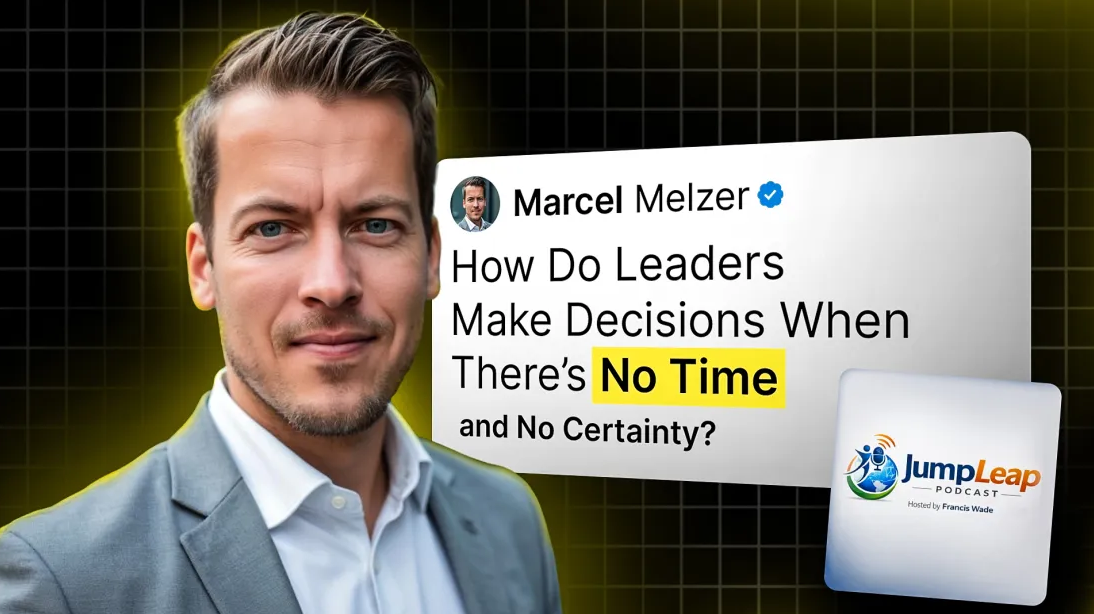
Ep 34 - How Do Leaders Make Decisions When There's No Time and No Certainty?

Ep 34 - How Do Leaders Make Decisions When There's No Time and No Certainty?

1 h : 23 min
Your company is bleeding. The tariff just hit. Your board wants answers. You have 48 hours. But sometimes the brutal truth is that the warning signs were there 20-years ago. In this episode, Marcel Melzer stops the scroll with his contrarian claim: strategic decisions should take 48 hours, not months. His “decision as a service” model combines strategic foresight with AI-augmented decision intelligence—delivering what traditional consulting takes 8 weeks to produce, in 2 days. The magic? It’s not about perfect information. It’s about deciding at 80% confidence while your competitors are still scheduling meetings. We deconstruct a fictional case live, revealing why companies confuse firefighting with strategy, why past non-decisions create present disasters, and why the future belongs to leaders who can decide fast under uncertainty. Jamaica just got hurricane-smashed—we need this yesterday.
The Inside Story of ASML's Focus and Business Strategy

The Inside Story of ASML's Focus and Business Strategy

15 min
The world's most powerful technology monopoly controls 90% of chip lithography while owning almost none of its supply chain. ASML's paradox: extreme market concentration built on deliberate dependency—80% of each machine manufactured by external partners—creating an ecosystem that absorbs industry cyclicality rather than internalizing it. Three mechanisms sustain this monopoly. A 10-to-15-year planning horizon locks customers into roadmap dependency before fabs break ground. Geopolitical neutrality—ASML supplying 90% of litho tools, TSMC producing 70% of advanced logic—makes customer favoritism commercially suicidal; both operate as semiconductors' Switzerland. Most critically: Arizona's TSMC expansion exposes human capital as the binding constraint—physical infrastructure replicates; tacit knowledge networks don't. For strategy leaders, the ASML model fundamentally reframes reshoring logic: the bottleneck isn't capital or policy—it's human ecosystem density accumulated over decades. The next competitive frontier isn't who builds the fabs, but who cultivates the knowledge networks that make them run.
TIMESTAMPS 00:00:48 ASML controls 90% of global chip lithography yet outsources 80% of machine components—monopoly built on managed dependency, not vertical integration. 00:03:28 ASML's 80% outsourced supply chain creates an ecosystem absorbing industry cyclicality—concentration without the fixed cost exposure of vertical integration. 00:07:38 TSMC supplying 70% of advanced logic and ASML 90% of litho tools forces neutrality—favoritism toward either superpower is commercially suicidal. 00:09:56 Arizona's TSMC expansion reveals the real bottleneck: fabs replicate in two years; the tacit knowledge networks sustaining yield take decades. 00:12:09 Semiconductor competitiveness requires radical directness—politeness adds latency, and in an industry where timing determines market windows, cultural friction is a strategic liability.
The Fall of Levi Strauss Factories

The Fall of Levi Strauss Factories

26 min
Levi Strauss executed a $3.3 billion leveraged buyout in 1996—precisely when sales peaked at $7.1 billion. As market share collapsed from 50% to 26%, debt service prevented competitive response. The company missed baggy jeans, premium denim, and teenagers entirely while competitors captured every segment. The failure reveals strategic timing risk: loading debt at market peaks. Levi's suffered middle-market compression—discount brands attacked below, designer jeans above, leaving no defensible position. Dockers generated revenue while core jeans eroded. When teenagers ranked Levi's eighth in 1997 versus third previously, the diagnosis was fatal: "Everyone has Levi's, including their parents." Cultural relevance disappeared. The pattern exposes brand-manufacturing divorce costs: Levi's closed all 63 US plants by 2004, eliminating 37,000 jobs, while marketing American authenticity. Competitors maintained limited domestic production or automated. Complete offshoring preserved profits but destroyed the worker class that built brand credibility—survival through institutional betrayal.

Strategic Timestamps

00:02:18 Davis lacked $68 to patent rivet reinforcement—Strauss funded patent for partnership, creating entire blue jeans category from minimal capital barrier. 00:06:46 San Antonio plant: 1,100 workers, $70 million annual output, integrated workforce—Levi's built communities through manufacturing before federal desegregation laws required integration. 00:10:32 Market share collapsed 50% to 26% (1990-1997) as Levi's missed baggy jeans, premium denim, teenager trends—caught in middle-market compression. 00:18:35 Offshoring became universal response, yet competitors maintained limited domestic production, automated, or marketed "Made in USA" premium—Levi's chose complete abandonment. 00:22:36 Every closure economically rational yet accumulated into institutional betrayal: survival built on worker sacrifice carries costs balance sheets never capture.
The Downfall of Bethlehem Steel

The Downfall of Bethlehem Steel

27 min
Bethlehem Steel built 80% of New York's skyline and more warships than any American company—then vanished. The failure wasn't foreign competition or union demands: it was Eugene Grace's 40-year reign creating a culture where innovation meant career suicide and outdated methods became sacred policy. The company clung to 19th-century open hearth furnaces producing steel in six hours while Japanese competitors adopted basic oxygen furnaces completing the process in one. When mini-mills like Nucor deployed electric arc furnaces with flexible work rules, Bethlehem dismissed them as incapable of matching quality. Meanwhile, the 1959 strike forced customers toward imports—jumping from 2 million to 5 million tons annually—and they never returned. By the 1990s, Bethlehem spent more on retiree benefits than raw materials. Nucor's survival reveals the pattern: market dominance without adaptation merely determines the altitude from which you fall.

Strategic Timestamps

00:02:16 Economic necessity drove iron-to-steel pivot: iron rails failed under heavy traffic while steel rails lasted longer and commanded higher prices 00:08:07 Bethlehem provided steel for 80% of New York's 1920s skyline—Woolworth, Chrysler, Empire State—owning vertical construction through H-beam dominance 00:14:12 The 1959 strike opened foreign competition permanently: imports jumped from 2 million to 5 million tons and never returned to pre-strike levels 00:19:04 By the 1990s, Bethlehem Steel spent more on retiree benefits than on raw materials—demographic inversion crushing operational competitiveness 00:24:18 Nucor survived through aggressive technology adoption, non-union plants with flexible work rules, and strategic facility location—opposite of Bethlehem's rigidity
Epic Disruptions: Insights from Scott D. Anthony

Epic Disruptions: Insights from Scott D. Anthony

2 h : 11 min
Disruption's deadliest trick: revenues spike before the crash. Research in Motion tripled revenue after iPhone launched—then tripled again—before falling off a cliff. Data becomes conclusive only when it's too late to act, making pattern recognition the superior strategic instrument. Scott Anthony maps disruption's architecture across 600 years—from Constantinople's walls falling in 47 days to Kodak buying Ofoto four years before Facebook. The mechanism: asymmetric motivation drives incumbents to rationally shed worst customers while entrants build on that abandoned base. Technology improves faster than needs evolve, transforming inferior offerings into dominant platforms. Dual transformation—reinvent today, create tomorrow, link capabilities—provides the structural response. Counterintuitive finding: disruption rewards crystallized over fluid intelligence—Gutenberg was 54, Ray Croc 52, Jobs 52 at iPhone launch. As AI reshapes consulting the way the printing press disrupted the Catholic Church, executives who recognize these patterns earliest will define the next competitive landscape.
TIMESTAMPS: 00:09:23 Asymmetric motivation: market leaders rationally exit worst customers while entrants build capability on that exact abandoned tier 00:23:24 Constantinople's Theodosian walls—moat, dual 15-foot walls, 96 towers—withstood a thousand years but fell to cannon in 47 days 00:38:56 Kodak bought Ofoto in 2000—four years before Facebook—but couldn't pivot from manufacturing to social networking business model 00:52:10 Bacon's 1620 reframe: pursuing knowledge shifts from heretical to heroical—the scientific method as history's most disruptive idea 01:02:08 Disruption begins at 50: crystallized intelligence peaks into the 70s—Gutenberg was 54, Croc 52, Jobs 52 at iPhone launch
Ep 33 - From Laundrylist, Wishlist or Checklist to a Game-Changing Strategy

Ep 33 - From Laundrylist, Wishlist or Checklist to a Game-Changing Strategy

49 min
Picture two teams in your company, six months apart.  The first team is drowning. They have 47 "strategic initiatives" on their list, no clear way to prioritize, and every meeting devolves into debates about resources. Morale is terrible, and nobody can articulate what they're really trying to accomplish.  Fast forward six months: the same team, but now they're energized, focused, and can explain their strategy in three minutes. Projects that don't serve their core hypothesis get killed quickly. They're making contingency plans because they understand their strategy is a bet, not a certainty. 

03:55 - Searching "strategic hypothesis" online makes executives more confused, not clearer—vocabulary alone won't save a strategy-less plan from board scrutiny.

08:05 - Teams mistake bureaucratic obligation for strategy, creating wish lists that satisfy checklists but fail Janet's "where's your overarching hypothesis?" test.

17:30 - When boards reject plans with 55 sensible initiatives, they're not critiquing ideas—they're exposing the absence of strategic cause-and-effect thinking.

52:09 - Strategy's brutal reality: everything's changing, data's flaky, and you get one shot at your hypothesis—not multiple lab experiments with do-overs.

57:21 - Six AI prompts reveal whether your plan contains testable strategic hypotheses or merely business-as-usual activities masquerading as surgical interventions.

What happened in between?  They stopped confusing a strategic plan with actual strategy. Today, I want to walk you through that transformation, because the gap between these two states isn't about working harder—it's about thinking differently. Tune into this episode to join me in tackling this wicked problem.  
The Private Equity Firm Buying All of Fast Food

The Private Equity Firm Buying All of Fast Food

12 min
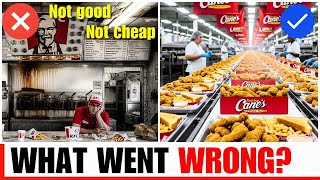
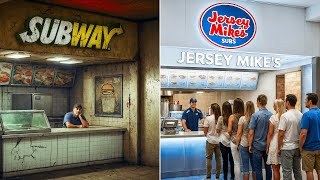
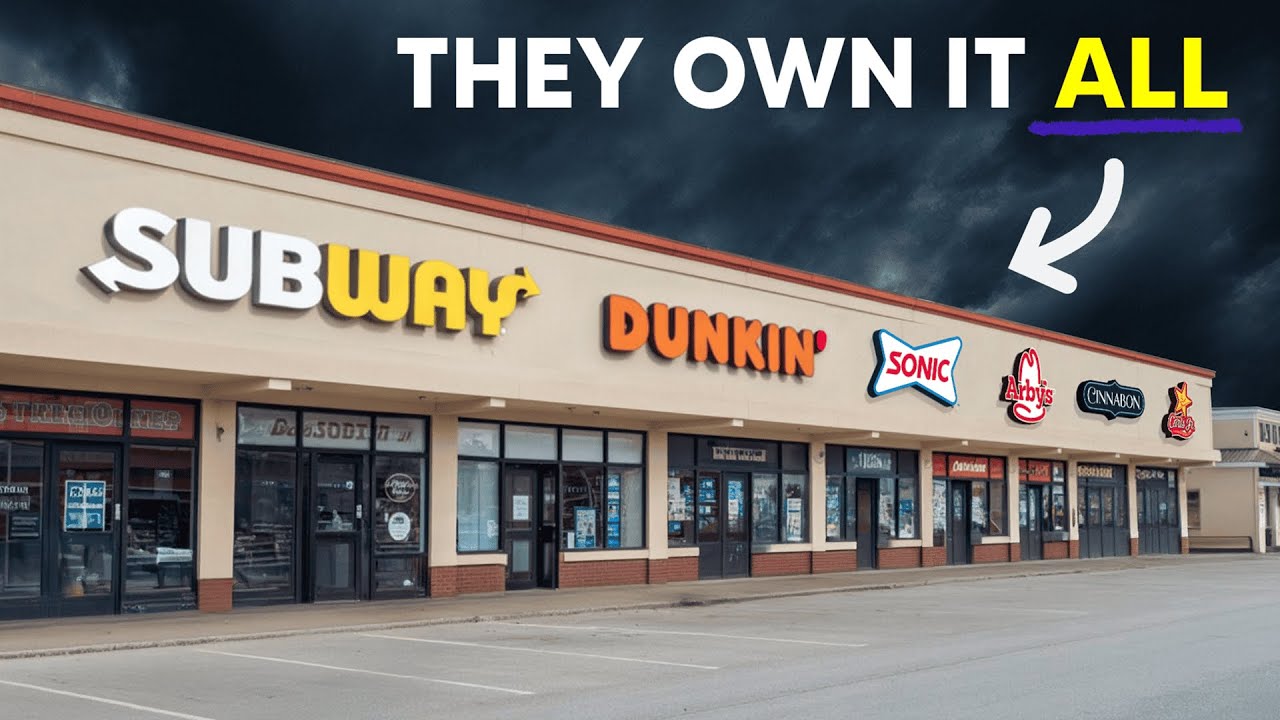
Conventional wisdom holds scale as the ultimate competitive moat. The counterintuitive reality revealed by Roark Capital’s 25-year empire is that mass aggregation can mask strategic fragility—acquiring 110,000 franchise locations may build financial assets, not defensible businesses. This case dissects the *platform roll-up strategy* and its critical tension: capital deployment versus operational stewardship. Roark, a $5B fund, exclusively targets franchisors—the royalty-collecting entities—not operators, creating a cash-generating ecosystem across Inspire Brands (Arby’s, Buffalo Wild Wings) and GoTo Foods (Cinnabon, Carvel). Yet, causality is inverted: systemic underperformance (Carvel’s footprint shrunk post-acquisition; Subway’s unit economics rank lowest in category) suggests value extraction over brand compounding. The strategic red flag is failed exit velocity—two aborted IPOs indicate markets are skeptical of a portfolio generating $100B in system sales but lacking demonstrable brand revitalization. For strategists, this is a masterclass in financial engineering’s limits. The forward-looking imperative is auditing *ownership duration* versus *value creation*; a 4-7 year PE hold period may be fundamentally misaligned with the late-stage brand compounding required for true multi-generational returns. Scale, absent operational alpha, is merely concentrated risk. ---

Timestamps

00:01:40 Franchisor investment thesis: Acquire royalty streams, not operations—licensors command high multiples (e.g., Blackstone/Jersey Mike’s) while franchisors handle unit-level risk. 00:04:02 Platform roll-up mechanism: Prove acquisition prowess with a $413M fund to raise a $1B war chest, enabling simultaneous scaling of multiple stagnant brand portfolios. 00:07:55 Scale versus quality paradox: 110,000 locations generate $100B systemwide revenue—3x McDonald’s units—yet key brands exhibit shrinking footprints and bottom-quartile unit economics. 00:09:28 Strategic red flag: Roark retains assets for 25+ years (e.g., Carvel), defying standard 4-7 year PE cycles, suggesting failed exits or reliance on late, uncertain compounding. 00:10:31 Performance skepticism: Two aborted IPOs (Inspire, GoTo Foods) and a graveyard of failed concepts (Ace Mortgage) signal market doubt about financial engineering as brand strategy.
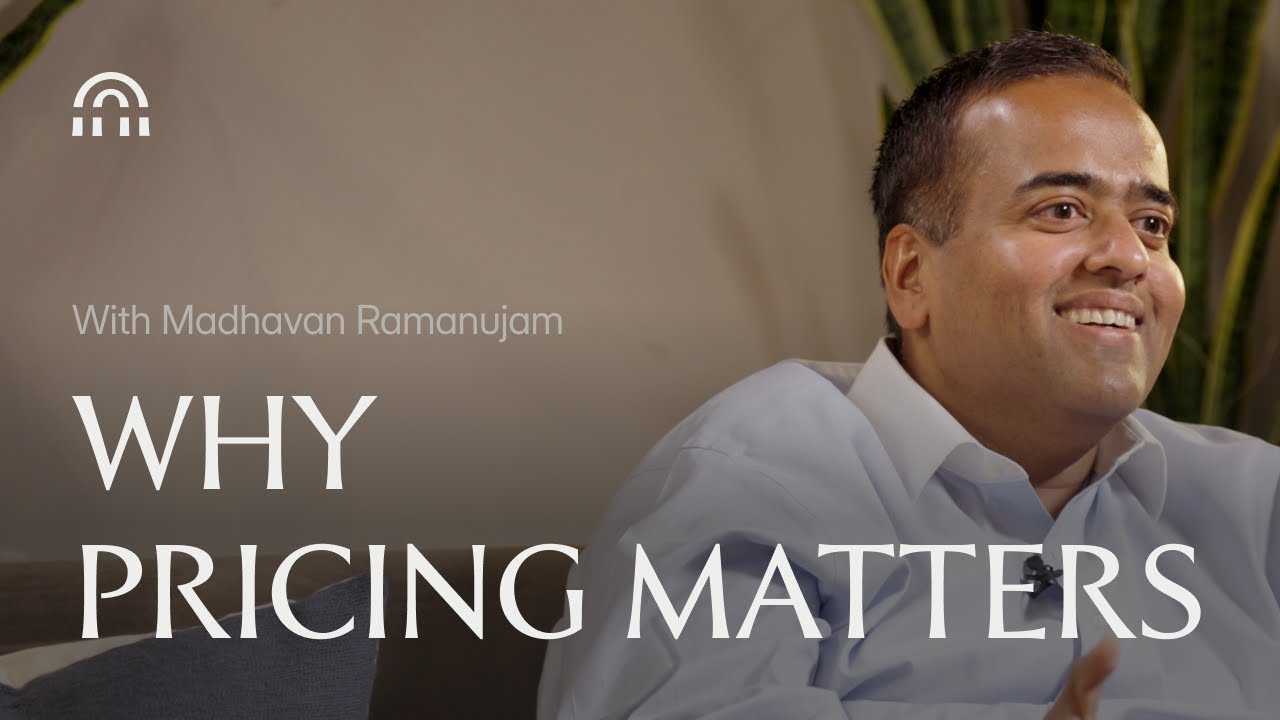
Monetizing Expert: Your Pricing Is Killing Your Startup

Monetizing Expert: Your Pricing Is Killing Your Startup

32 min
Pricing isn't an afterthought—it's a strategic weapon most founders deploy too late. The counterintuitive reality: testing willingness-to-pay before building product prevents the billion-dollar mistake of training customers to expect more for less. The Pareto principle governs value perception: 20% of features drive 80% of willingness-to-pay, yet founders typically offer that high-value 20% free, then chase low-value features customers won't pay for. LinkedIn succeeded where Plaxo failed by delaying monetization strategically—testing pricing signals early while building critical mass, then layering talent-side, sales-side, and consumer monetization sequentially. AI companies face new trade-offs: autonomy (copilot vs. agent) and attribution (productivity vs. outcomes) determine optimal pricing architecture—seat-based for low-autonomy/low-attribution, hybrid for increased attribution, usage-based for infrastructure plays, outcome-based for fully autonomous attributable agents like Intercom's resolution-based model. The strategic imperative: architect toward profitable growth by balancing market share capture with wallet share expansion simultaneously. Price before product, period—willingness-to-pay conversations precede development, not launch.

5 Timestamps

00:03:45 Netflix beat Blockbuster through pricing model innovation: subscription with no late fees versus per-title rental—how to charge mattered more than product differentiation 00:08:45 Product-market-price fit requires testing willingness-to-pay during development: asking "do you like sparkling water at $10?" changes conversation versus product alone 00:12:15 Pareto value paradox: 20% of features drive 80% willingness-to-pay—founders give away high-value 20% free, then build 80% low-value features customers won't buy 00:16:57 AI pricing model framework: autonomy (copilot vs agent) and attribution (productivity vs outcomes) determine architecture—seat-based, hybrid, usage-based, or outcome-based positioning 00:27:41 Behavioral anchoring case: presenting $500K fixed versus $50K plus 10% outcome enabled 10x price realization through choice architecture and courage signaling
Butch Stewart: From Selling ACs to Becoming the Tourism King of Jamaica
13 h
Jamaica's Limestone Expansion
31 h : 3 min
Ep 34 - How Do Leaders Make Decisions When There's No Time and No Certainty?
1 h : 23 min
The Inside Story of ASML's Focus and Business Strategy
15 min
The Fall of Levi Strauss Factories
26 min
The Downfall of Bethlehem Steel
27 min
Epic Disruptions: Insights from Scott D. Anthony
2 h : 11 min
Ep 33 - From Laundrylist, Wishlist or Checklist to a Game-Changing Strategy
49 min
The Private Equity Firm Buying All of Fast Food
12 min
Monetizing Expert: Your Pricing Is Killing Your Startup
32 min
Jump-Leap Long-Term Strategy Podcast

jump leap 3 trans png
1h : 00m

Recent Episode

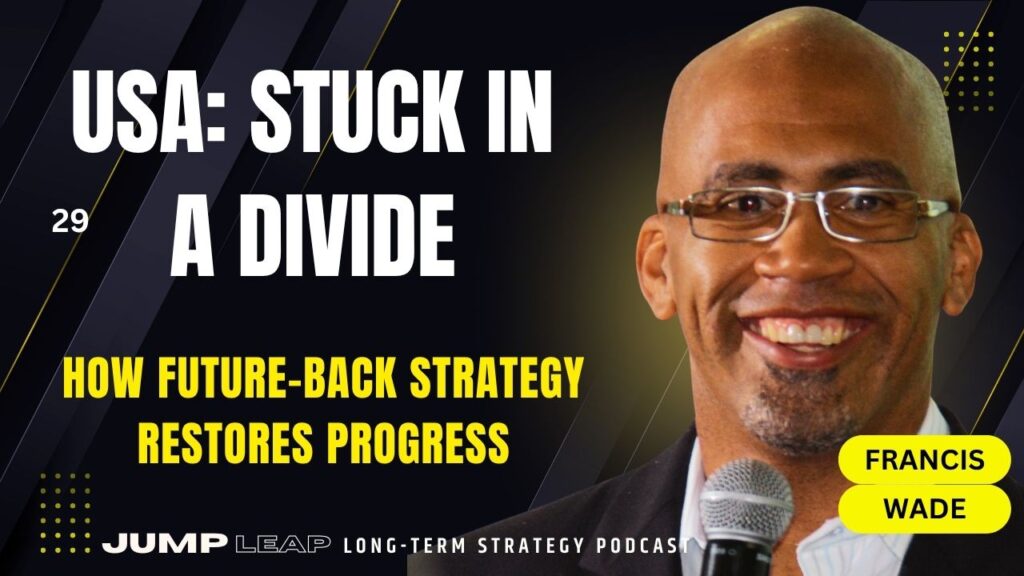
Let’s imagine for a moment that you are a citizen or resident of the USA. You love the country and especially the vision of the founding fathers. However, you are distressed by the degree of the political divide. It has hijacked popular attention. People seem to hate each other. Is there a way to find inspiration beyond the current uncertainty? Can leaders possibly come together if only they took a long-term view of the country, and the world?